Seating Plan Matters to Ms.Steinem
Gloria: A Life opens with “Gloria” removing her famous aviators and eliciting a cheer (hopefully) from the audience when she declares the following “good news”:
We’re all in this room together and not alone on our computers or cellphones!
Yay!
Humans are communal animals. We’re meant to be sitting around campfires telling our stories, learning from each other. We’ve been doing it for millennia...
The script goes on to give some instructions on the seating plan:
In fact, I would say being able to tell your story and listening to each other’s stories is the surefire path out, because you realize you’re not crazy.
The system is crazy.
And you’re not alone.
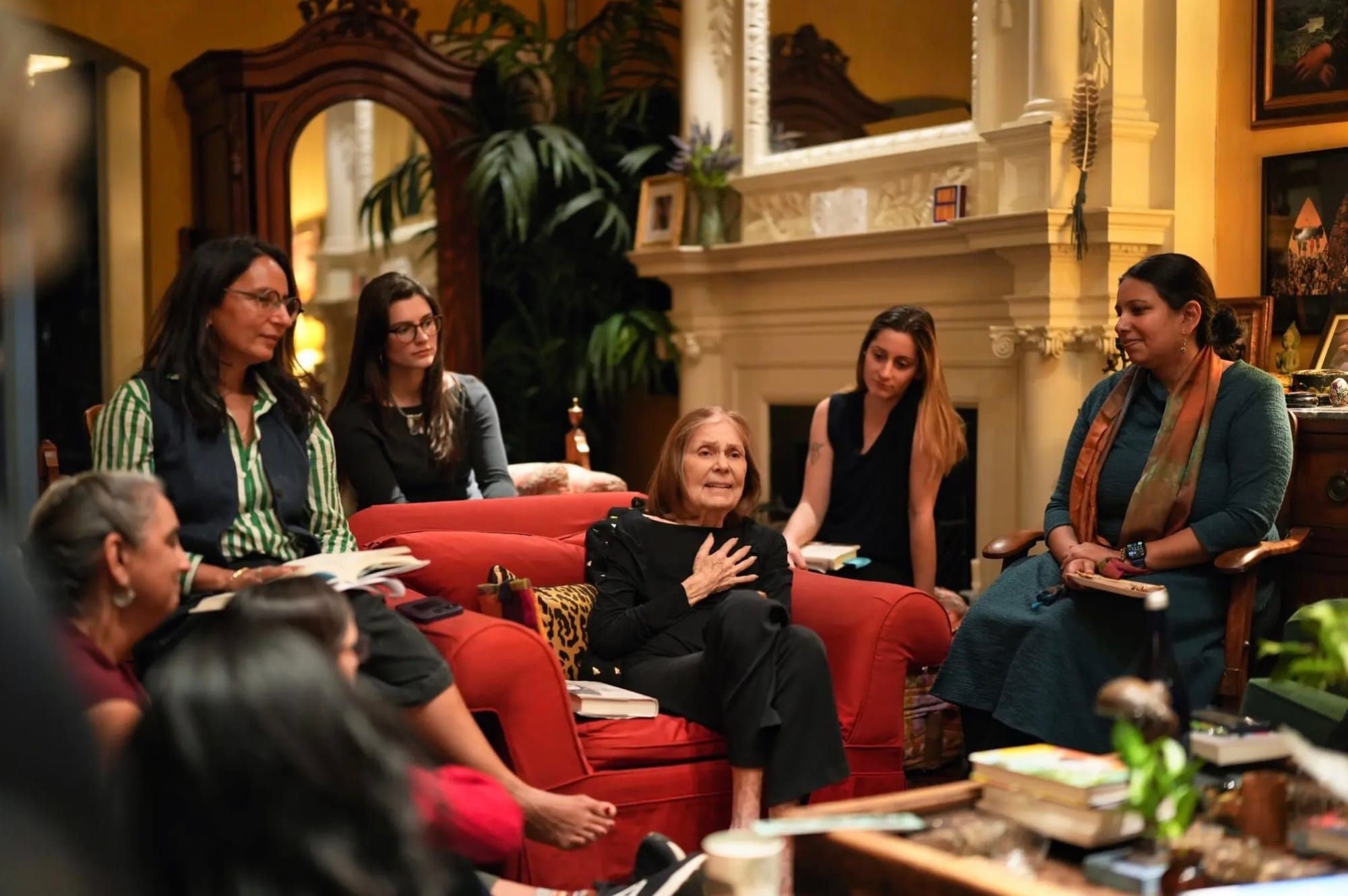
Social justice movements start with people sitting in a circle, like this.
Well, that’s the beauty of a black box. You can decide how you want the seating. And, if the playwright tells you that you are sitting in a circle, it is easy to oblige.
I would set up my set exactly like Gloria Steinem’s living room. I can tell you why some of these choices, like that red chair, are plain old great set design choices. But I think we probably can’t codify why this exact set-up facilitated 50 years of conversations that shaped our world to an astounding extent.
Quantity of chairs = tickets sold?
That seems to be the current wisdom—always make it a “full house”. An awkward game of musical chairs is not a bad way to start an experience. When you have counted correctly, it always seems like you are one down. It forces us to sit next to folks we would not otherwise; and smile at them as a hello while we lower our tushes gingerly into a little less space than we would like.
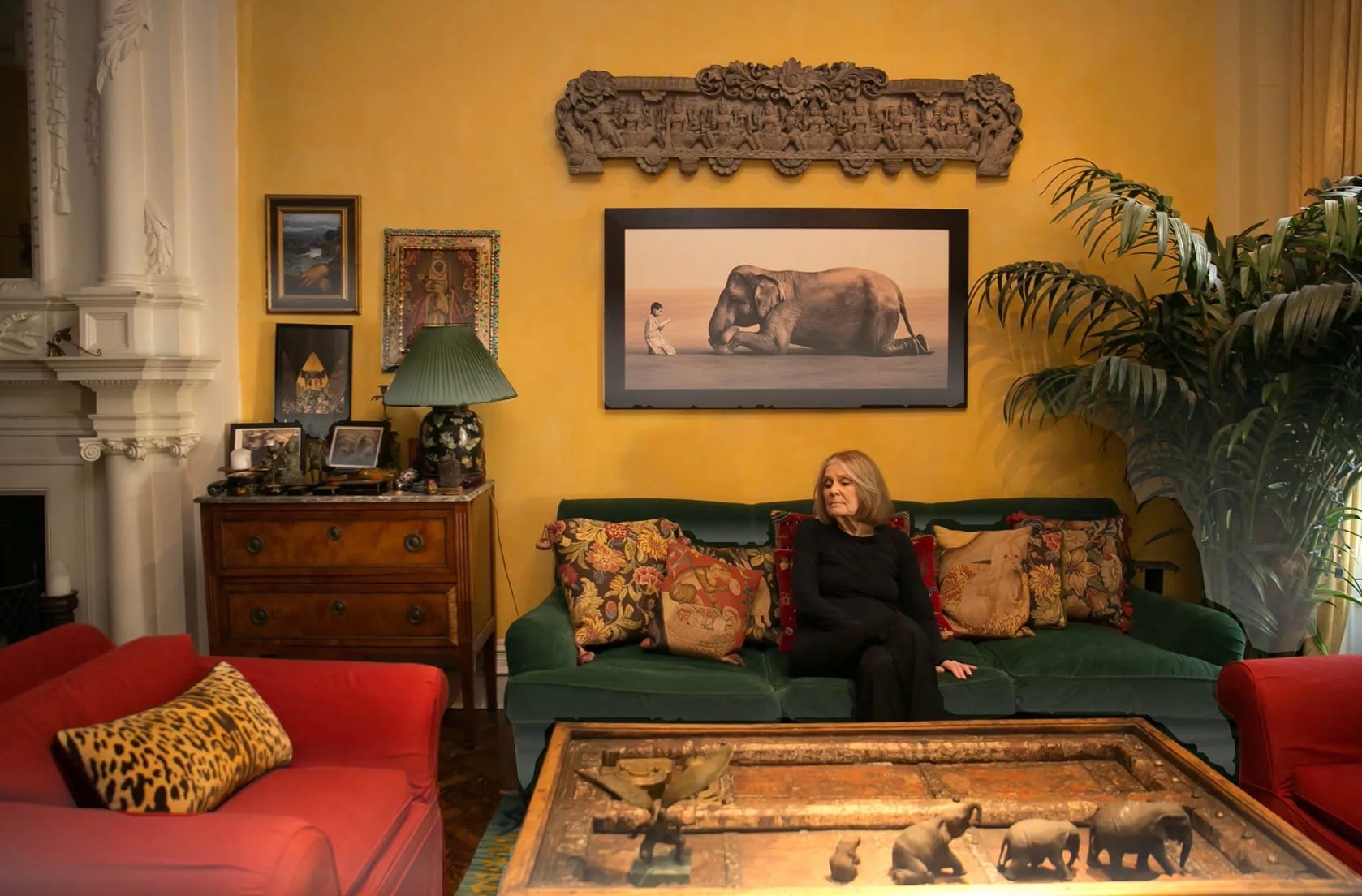
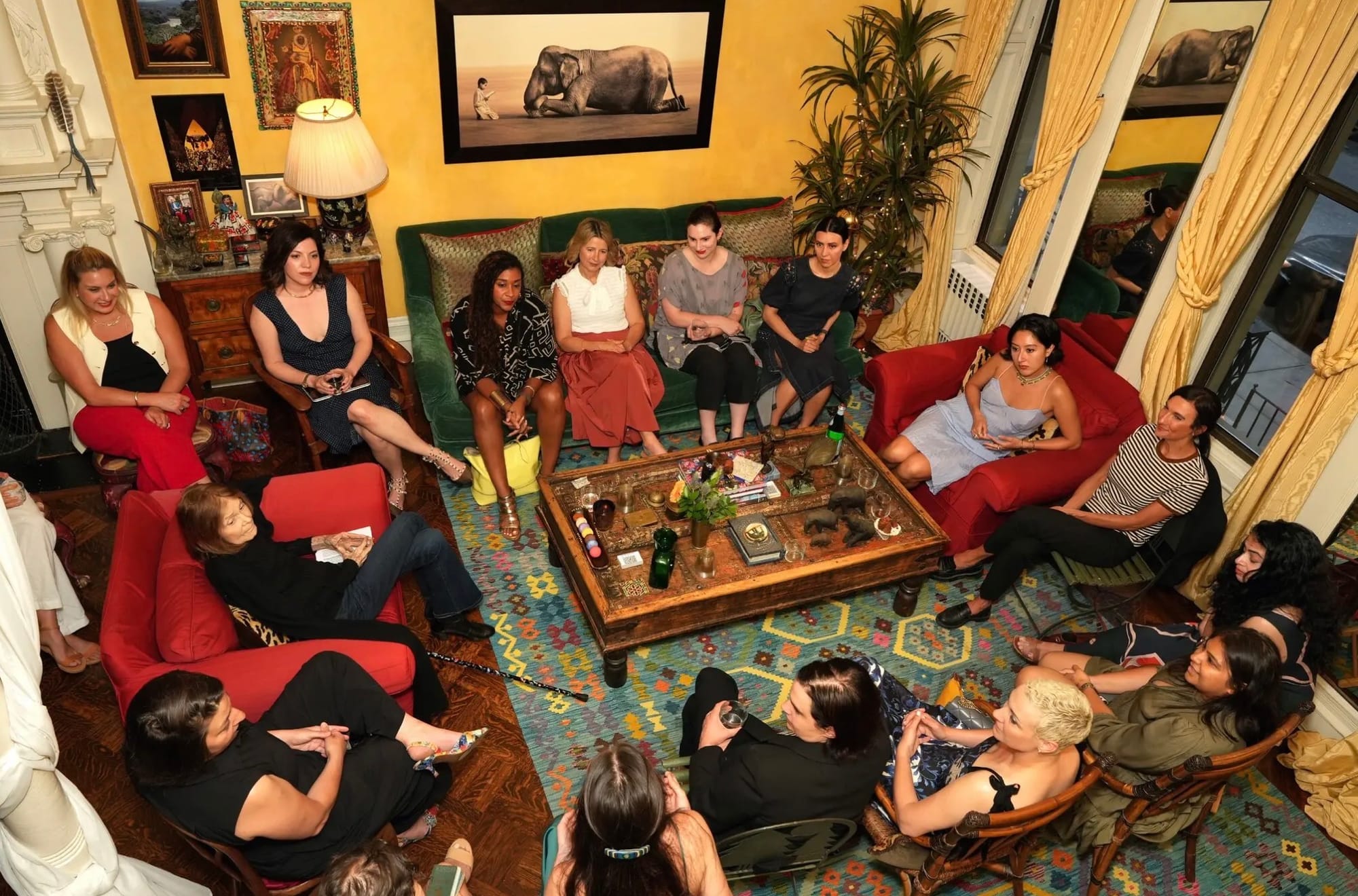
Ms. Steinem’s living room looks to have a seating capacity of ~Gloria + 4 …but in Most conversations 18 are invited.
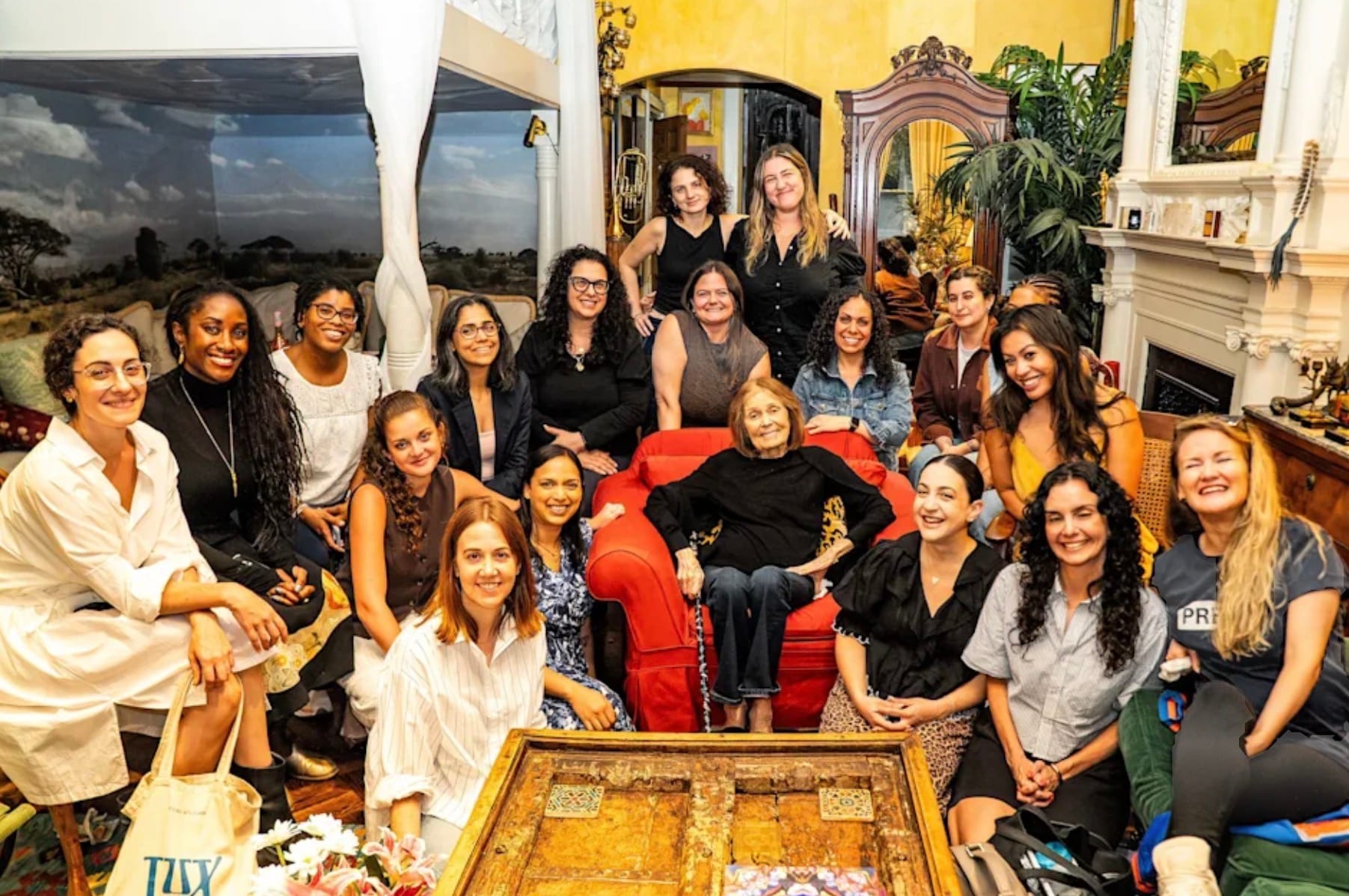
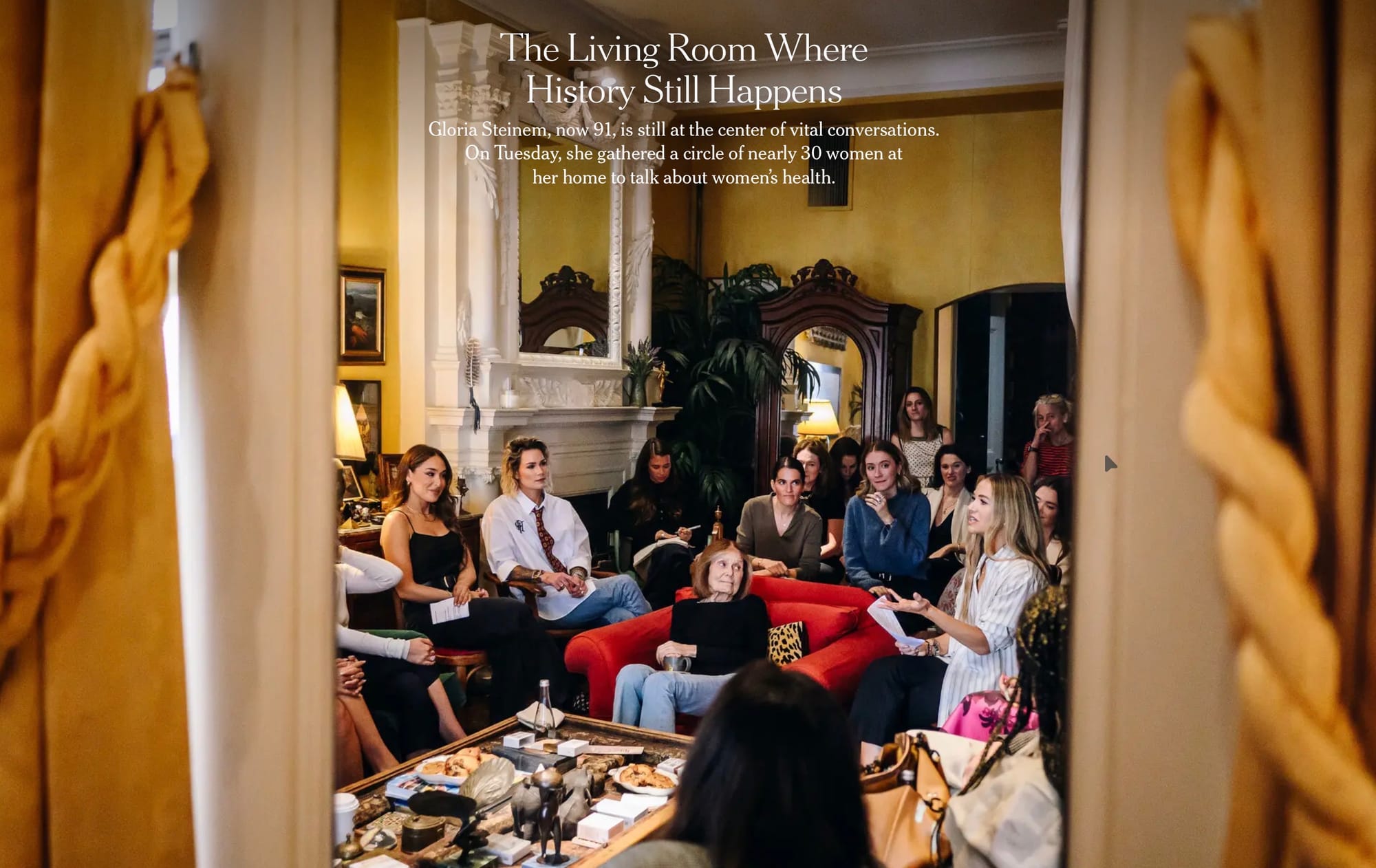
And the health conversation the NYTimes covered had 28 + Gloria.
…but the coffee table always stays…that room looks about ~12’ x 24’...you could fit 50 chairs if the table came out and the chairs faced one way….
A pillow on Ms. Steinem’s bed reads, “The power of the world always works in circles”…tell that to theater-makers—we tend have been taught to prefer the triangle—everyone in the room facing a single figure elevated on stage in front of you. Usually this star stands and the rest of us sit.
Someone is always looking at the back of the actor’s head in the circle configuration. So, some moments are going to land really well with one side of the room and less well for the other side. This is true of all seating arrangements, though to a lesser extent if the audience and actor are in that traditional face to face set-up.…and in the circle everyone’s view is equal…equally bad.
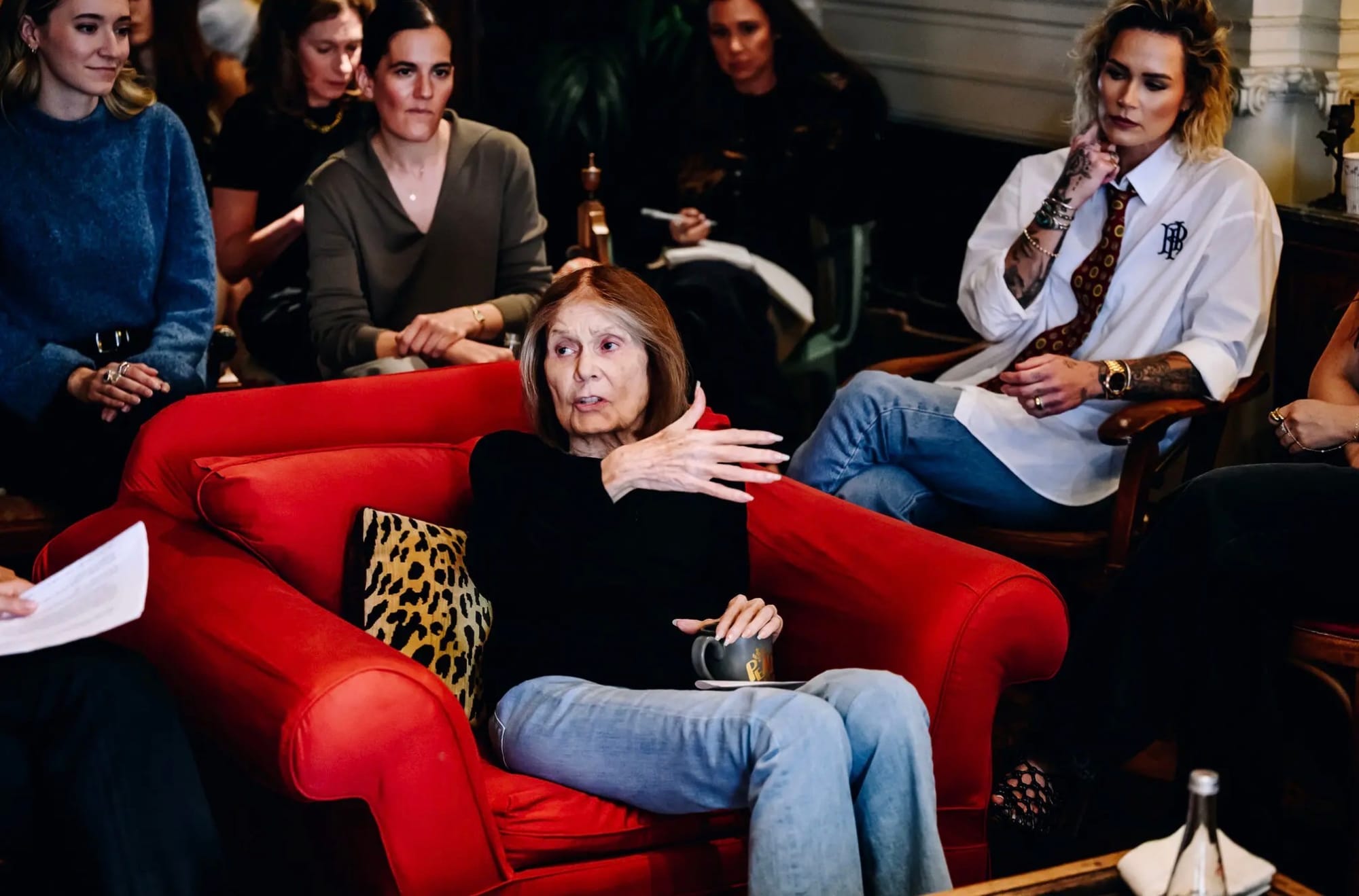
Ms. Steinem understood the back-of-the-head problem is far outweighed by one huge benefit to sitting in a circle that the script points out immediately:
We called [sitting in a circle] consciousness raising.
Yes, you’re nodding.
You remember.
You remember, too!
It’s all about sharing what’s wrong and what to do about it.
And there is so, so much to do.
The audience gets to look at who else is there and what they are doing! They get to see the nods, too! This is obviously great for us theater makers…audience research made easy. However, I think all of us in multi-generational audiences need to see Gloria’s contemporaries nodding. When she says, “Young people are mad.” You will likely see deep nods. I didn’t know young people were mad until I watched a round-table-like school committee meeting. Blow-you-back anger.
Our minds may wander — but not as far as they usually do in a theater or a classroom — because our faces are part of the picture.
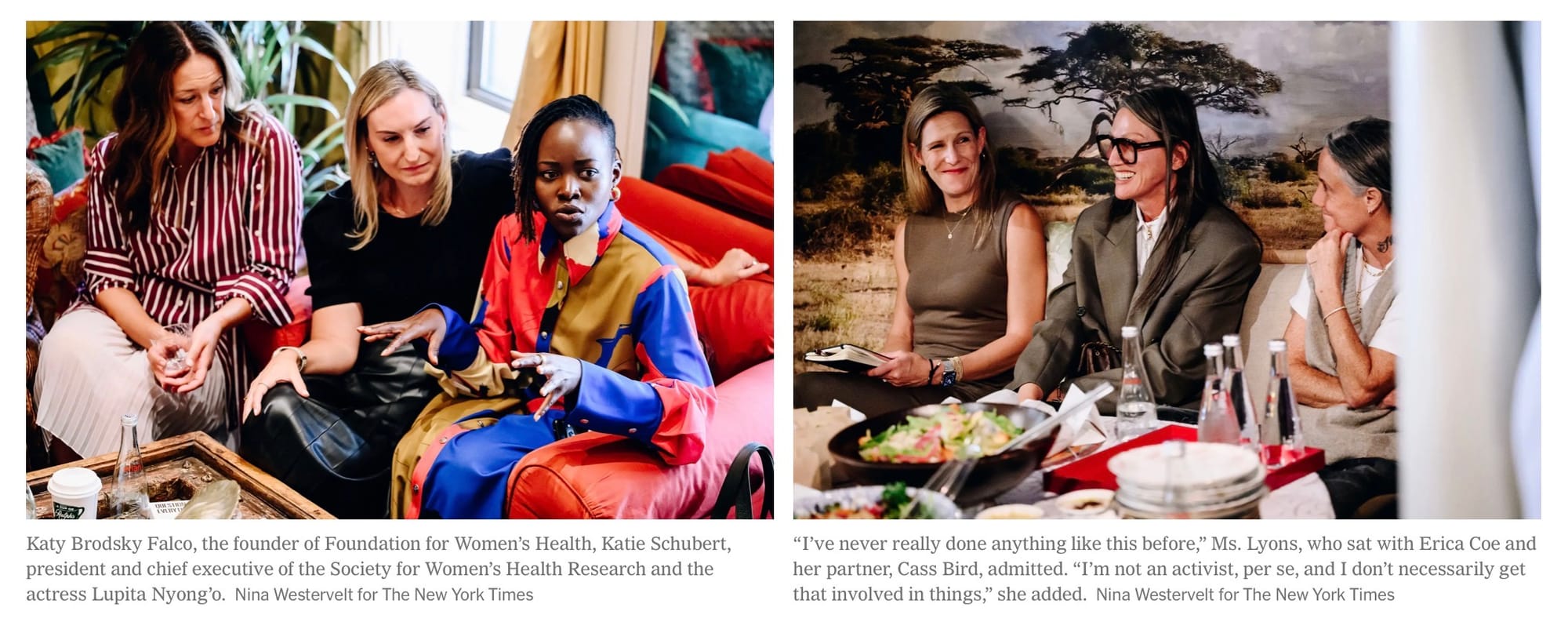
The New York Times took these photos last year. They said this conversation was about women’s health…Lupita Nyong’o is there because she talked about her problems with fibroids(?). She is sitting on a couch with nonprofit leaders. That woman in the glasses is there because her photographer wife was invited…the weird assemblage of people in the weird assemblage of seating is something theater does, but less explicitly. A bunch of consenting people agree to sit in a room for a while to be witness to a discussion about a topic chosen by the theater/director/Ms.Steinem.
In this case, there are so many people in the room that you must spend most of the time listening…maybe your main participation is nodding.
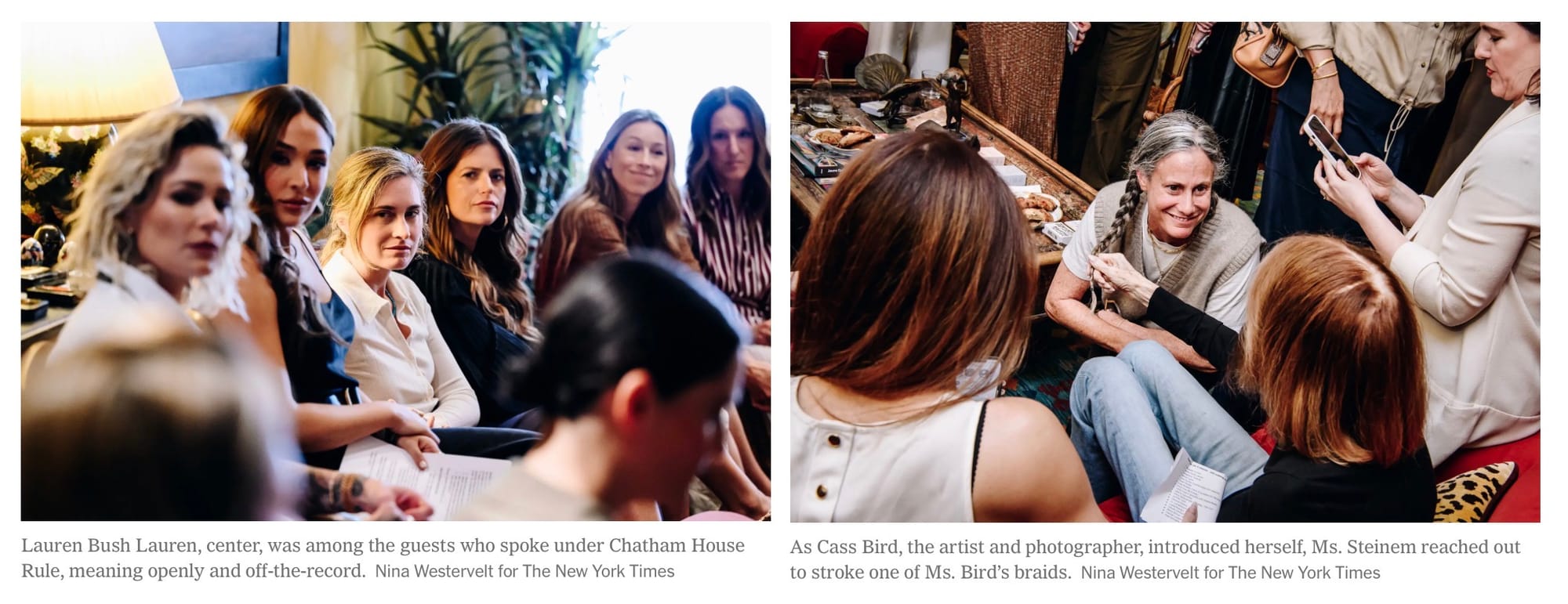

Not to get nitpicky…but this is an oval, not a circle. Ms.Steinem does have a powerful position in that low, large red chair at the egg end of the oval. Also, the stadium seating behind her makes her end more interesting to look at.
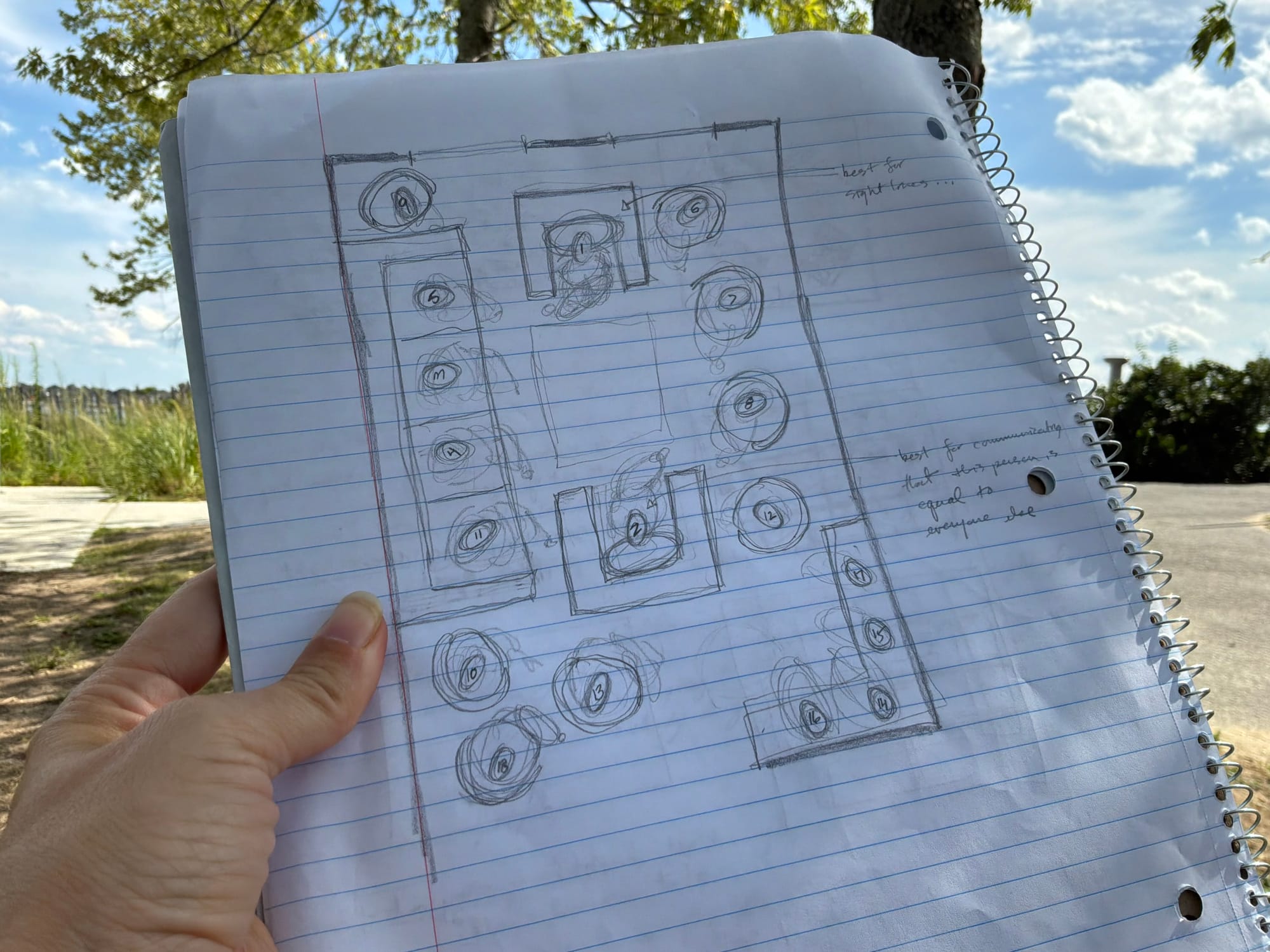
If there is a center to that “circle” she is the closest to being in it. But she is low. I actually think that the red chair in front of the windows (I gave it the #1) is the most powerful position. That might be why Ms.Steinem chose the #2 red chair. So, there is no clear ”head-of-the-table”.
“The paradigm of human organization for [the Cherokee nation] is the circle, not the pyramid”, which is also the basis for the US Constitution, as per Ben Franklin’s employment of Iroquois consultants to make the constitutional convention, and the use of the word “caucus”, which is the Algonquin word for talking circle. Finally, and most pointedly, the Iroquois confederacy is the oldest known democracy. This Government 101 lesson was imparted to Gloria by the head of the Cherokee nation, Wilma Mankiller. It was the “blinding light in my brain” awakening moment for Ms. Steinem. There is a proven way to be together as humans that does not involve patriarchy, or hierarchy at all. It is the form of government that originated and functioned in this bit of geography; and! It is the basis for our government.
(…we just got a few of the details wrong. The Iroquois consultants pointed that out, though: “Where are the women?” Was their first question when they met our ”founding fathers”.)
In forcing us to stage this show in a circle she is forcing a Hero’s-Journey linear, hierarchical industry - American theater - into an uncomfortable arrangement. Can we sit through a show with a protagonist that insists that she is not the star? Nor the guiding force of this narrative? Can we maintain focus on mostly her when there are so many other faces to look at?
When playwrights put a seating arrangement in the stage directions, introduction or even a legally binding pre-amble…we theater folks feel free to ignore it if we can’t ‘make it work’ for our specific production. …but she and Emily Mann wrote it into the opening speech…circle it is.
No hierarchy! Set design is not metaphor. It is a real working human relationship to things, space and most importantly — other humans.
Wow… and… difficult.
It is easier to sit back relax and be entertained. Or, sit back, incredulous and reject what we are hearing while sitting quietly. It is even easier to sit up and nod and cheer for someone else while we sit in our seats. hmmm…seated in a circle we can’t even do the easy follow-the-director’s orders about where to put our eyes or ears. The circle is contrary to our training in how to take in stories… or participate in conversations… Or stage theater!
I see you, Ms.Steinem...or, at least I see the back of your head…and I accept this challenge.
Lighting design class at Yale started with a fully freeform discussion of a play—and ended with a clear concrete question:
Where would you stage this show?
Tomorrow I am going to think out loud about the challenge of lighting a show in the round. Even in a wonderfully well-equipped black box theater — which is what I think Cypress Stage has chosen for their production — keeping the lights on the actors and out of the eyes of the audience wants a patient and precise lighting approach.
However, a good black box is what most of us theater folks would choose…in a place like Cypress, Texas.
But, what about a home? Like Gloria’s? I will send you the scripts while you gather all your garden stools.